

Know Thy Neighborhood
My trial-tested commandments for feeling at home as a girl who's done a lot of moving around.

I grew up in Sheboygan, Wisconsin. This is a fact that people laugh at when I tell them. Whether it’s because the name sounds funny or because they somehow know how small the town is just by how I say it, I can’t tell. It’s probably one of the first words I learned so, 25 years in, it just sounds like home to me.
My neighborhood was nestled into woods that ran into the nearby state park. Once I had taught myself to ride a bike, I explored every inch that I could. The creek that ran under the bridge was where the neighbor kids and I looked for crawfish and where I first learned the f-word from some very informative graffiti. There was a small trail that ran through a ragtag sculpture garden, but if you veered off to the right at the fork, you’d be led deeper into the forest, until the sound of passing cars could just barely be mistaken for the wind.
It was there that I spent hours looking through the tree branches, following along the bank of the creek, looking for clues to some ancient mystery, trying to identify scratches on the trees as secret messages from giant brown bears, and climbing over trees that had fallen long before I ever entered the forest.
I didn’t know it then, but what I was doing was a grounding practice. I was aware of my surroundings, listening intently, looking at everything around me, taking in deep breaths of pine and dirt, and gripping the rough tree bark as I climbed on and off the path.
I knew my neighborhood and I knew it well. As I continue to go through life, I’ve lost touch with this practice. Louder, brighter, and faster-moving things distract from the ordinary. I find myself so wrapped up in digital simulacra that I forget the very real existence I’m surrounded by constantly.
On top of those distractions is also the fact that Western society as a whole is much more mobile than it used to be. We are only a couple of generations separated from people who viewed being born, living, and dying in the same town as the status quo. When we are so desensitized to picking up and starting new lives, sometimes as often as every five or so years, we tend to forget that moving can be hugely disruptive to the mind.
From ages 16 to 23, I moved every 2-3 years. Family took a new shape and home became just a word. Starting over so often was destabilizing for me, and as much as I tried to ignore that fact, it always chipped away at my feeling of safety in the background. It’s only now that I’ve chosen to stay put that I feel that difference. Meaning starts to move back in.
As I write this, Amundsen High School sits across the street from me. It doesn’t mean anything to me, but I know which of my neighbors have signs in their yard announcing that their child attends school there. I also know that if I’m describing where I am, I could mention Amundsen to a friend who’s lived here much longer than I and they would know what I’m talking about. They might know someone who went to school there or they themselves might’ve went to a rival high school in the city and instantly it becomes something more meaningful than a brick and stone building that I sit and look at in between paragraphs. I am reminded that it means something to somebody. The world fills back up with meaning during an age where meaning erodes on every front.
The greatest realization I’ve ever had was that a home is something you can create. And so, I’ve created a list of commandments for feeling at home for the ever-searching wayward soul, as someone who’s needed it the most.
1. Listen To Who’s Speaking
When I lived in Orlando, I got really into identifying birds. My partner at the time introduced me to an app called “Merlin,” which is like Shazam for birds. You can take pictures or record audio, and the app will tell you who you’re seeing or hearing.
I adopted the habit of sitting outside and observing. Over time, I’d start to recognize certain calls. The song of a red-winged blackbird stood out from the song of a Florida scrub jay. I knew the bird perched precariously atop a cattail was a Boat-tailed Grackle rather than a Common Grackle. I’d be on walks and, without even trying, my brain would single out a voice and recall its name effortlessly. It was akin to learning a new language, feeling excitement every time my subconscious effortlessly picked up on something.
The place I lived, my neighborhood, my home, became a little less strange as the sky started to fill with familiar voices.
My habit of listening for birds turned into a habit of listening to everything. The recording you’re listening to was taken near Lake Underhill in Orlando, my old neighborhood. For just over 13 minutes, I sat silently, perhaps with a book or with my dog or with nothing at all. At times, the sound of an airplane becomes deafening in comparison to the soft chirping of birds and, although it’s annoying, it reminds me that I lived near an airport, a fact I might have since forgotten.
My old phone is full of recordings like this; moments I wanted to savor and return back to one day. There are recordings taken while lying next to a beloved friend on a sunny day, or during a dinner with loved ones, where you can hear soft chatter and the sound of metal against ceramic while someone finishes up their meal. Each one is a reminder that at some point, I was so happy and absorbed in the noises that surrounded me, I wanted to save them for later.
Although I love my headphones and I love listening to music while I walk and take the train, I’ve had the most tender experiences when I allow myself to listen and be a part of my surroundings. How will you feel at home if you can’t describe what home sounds like?
2. Observe The Comings and Goings of Critters
This one is my favorite. There are few greater simple pleasures than watching your neighborhood from the front stoop. People watching is phenomenal, yes. But critter watching is unmatched.
Your image of the neighborhood will begin to fill out. Who lives here? The monolithic term “critters” breaks down into repeat guests that grace your street, or yard if you’re lucky enough to have one. “Birds” turns into robins and black-capped chickadees while “rodents” turns into squirrels, chipmunks, and, of course, rats for the city-dwellers.
The practice requires you to sit quietly for some time. As you settle into your spot, reading or drinking a cup of tea, they’ll slowly reveal themselves to you. Observation, here, is a thing to be earned.
At first, their movements seem irregular. But the longer you watch, the more patterns you recognize. Just last week I was startled when a grey cat crossed in front of my steps with a small mouse hanging from it’s mouth, unaware of my gaze. I thought about the odds of witnessing something so interesting, like a momentary glimpse of a life that was so in the middle of itself. But only a few minutes passed until the cat strutted in front of me again, returning from where it came. It’s hunting, I thought.
This is not so much a novel insight, but an attempt at wrapping my mind around the reality that life is happening all around me, for everyone, all of the time. Even little grey cats.
I was better about keeping up this habit when summer was cooling into fall. I’d toss a handful of birdseed onto the grass and the steps, trying to coax the birds into coming closer. After a few consistent days of this practice, I noticed them braving the top step, but still too shy to land on the ledge next to where my chair sat. It makes me wonder what length of trust I could establish with them if I kept at it consistently over months rather than days.
When you’re not used to staying in one place for very long, that long-term daydreaming starts to slip. When I realized I could develop an actual relationship with the birds outside my apartment, it also occurred to me that I’d been craving that kind of stability, of envisioning myself in the context of the future and not just the past and present.
The critters are real. You are real. And I recommend this practice purely on the basis of the joy it can bring to your life.
Pro tip: keep a jar of birdseed on your stoop.
3. Become a Regular
Usually, when this advice is doled out, it’s with the insinuation that this is a good and effective way to make friends. I wholeheartedly reject that notion. Having been on both sides of that interaction, as a lonely customer and as a propositioned server, I can tell you now it never works. Becoming a regular isn’t about trying to make friends with your local less-than-friendly barista, it’s about entering the ecosystem itself.
In that first year after moving to Chicago, I had made it a priority to visit every cafe within walking distance. I tack on tags in my head as a means to categorize them. I know which have the best food, which have the best coffee, and which have the most accessible power outlets. So when a friend comes to the neighborhood, I know exactly which direction to point them in depending on what they’re looking for.
I love that the comfort food I eat as I write this section is the same comfort food I had during those first few months of moving to Chicago, when everything was big and scary and unknown. I’ve changed in countless ways since those first days, but the Pad Thai from that restaurant hasn’t. It’s a part of my story because I once chose it and I continue to choose it. This is a huge reason why I am so anti-Doordash et al; frictionless food delivery is so impersonal and nihilistic at its core. There is every reason for me to eat at a place in my own neighborhood, most of all because it’s just what’s there when I walk out my front door. I am simply not interested in algorithmically chosen dinner spots.
To know the restaurants and cafes in the area begets a sense of soft control. Your surroundings become less unknown. You “unlock new areas on the map,” as it were. You pick up on street names and hole-in-the-wall places that fill out your understanding of the neighborhood. Ordering dinner ceases to be a perfunctory act of survival, it’s a moment of human connection, of discovery, an opportunity to make someone smile or to let someone make you smile. It’s not always that, but you’re opening yourself up to the possibility of that, a possibility which doesn’t exist if you don’t leave your house.
I know that if I leave my house right after ordering my Pad Thai for pick-up, I will arrive at the restaurant almost exactly when it comes out of the kitchen because the restaurant is a perfect 15-minute walk from where I live. There are few simpler pleasures than that.
4. Become a Steward
My grandma always had this funny habit of spying on her neighbors. When we’d stop in to say hi, she’d often recount all the notable occurrences. The neighbors across the street put a new garden in (“they only eat organic vegetables,” she’d explain with a wrinkled nose) or the neighbors down the road had a beat-up pickup truck parked outside for the past few days (“I just don’t know whose it is!”). I used to think this was just a quirk of hers, but I’ve come to realize it’s the mark of a person who feels at home in their neighborhood.
To become a steward of the neighborhood, to watch over and notice things about it, means you care. You have decided to insert yourself into the comings and goings around you because you believe that it matters.
In a big city, this one is hard to keep up with. Things are always shifting, different people are always walking past your window, and you most likely live on a street with multi-family housing, making it impossible to spy on your neighbors to the extent that my grandma did.
But there are still small changes that you can keep up with. When the flower beds in my neighborhood were refilled with fresh, pungent mulch, it was hard not to notice. You could smell it from a block away! When the new bakery opened up, the smell of freshly baked bread wafted down the street early in the morning. When construction began on the house on the corner, I could’ve found it with my eyes closed. Not only because of the sound, but because of the strong scent of fresh plywood.
These simple recognitions made me feel at home. It was, as silly as it sounds, empowering to feel like I had a good eye on what was happening around me. I wasn’t a guest in the neighborhood, I was a part of it. And as a part of it, I felt right keeping my eye on what little I could.
5. Be Inconvenienced
I once successfully convinced four friends to move to Chicago in the same year. My simple pitch? It’s a walkable city with public transportation.
There’s surely something to be said about the freedom of navigating Chicago on foot (I would rather convert to being a Bears fan than try to find parking in the city), however I think the real pleasure is that walking and taking public transit gives you exposure to your neighbors. I love sitting on the bus when someone gets on and addresses the bus driver by name. I love sitting on the train and looking up and recognizing the person across from me. I love walking somewhere and getting honked at by a friend driving past.
With working from home, food delivery, and grocery delivery, I could easily stay hidden inside my apartment. It’s become way too accessible to have everything you need brought directly to your door. And I definitely lived that way for a minute. But the absolute joy of recognizing your neighbors is worth tenfold what the joy of staying on your couch all day is worth.
Go run your errands! Kurt Vonnegut put this very elegantly in A Man Without A Country. In the chapter “I have been called a luddite,” he describes his experience buying an envelope, finding pleasure in the people he meets in line at the convenience store, the woman at the post office he’s in love with, and even the mailbox he puts his envelope in. He ends this story with:
“And I go home. And I have had one hell of a good time. Electronic communities build nothing. You wind up with nothing. We are dancing animals. How beautiful it is to get up and go out and do something. We are here on Earth to fart around. Don’t let anybody tell you any different.”
6. Learn the Context
When I first moved to Chicago, I soaked up every piece of city history I could. The word “Chicago” comes from the Algonquian word šikaakwa, which describes the wild garlic field that populated the location that the city now sits on.
In 1871, The Chicago Fire burnt down 4 miles of the city, forcing the city to rebuild, which led to its first skyscrapers. The city is a mosaic of ethnicities due to its abundance of industrial jobs and easy access via trains in the late 19th century and throughout the 20th century. And between 1910 and 1970, The Great Migration saw Black southern culture make its way up to Chicago, ushering in the Chicago Black Renaissance and introducing jazz and blues to an already culturally diverse city. Behind every beautiful thing about the city, there is a long and interesting history that explains why it must be.
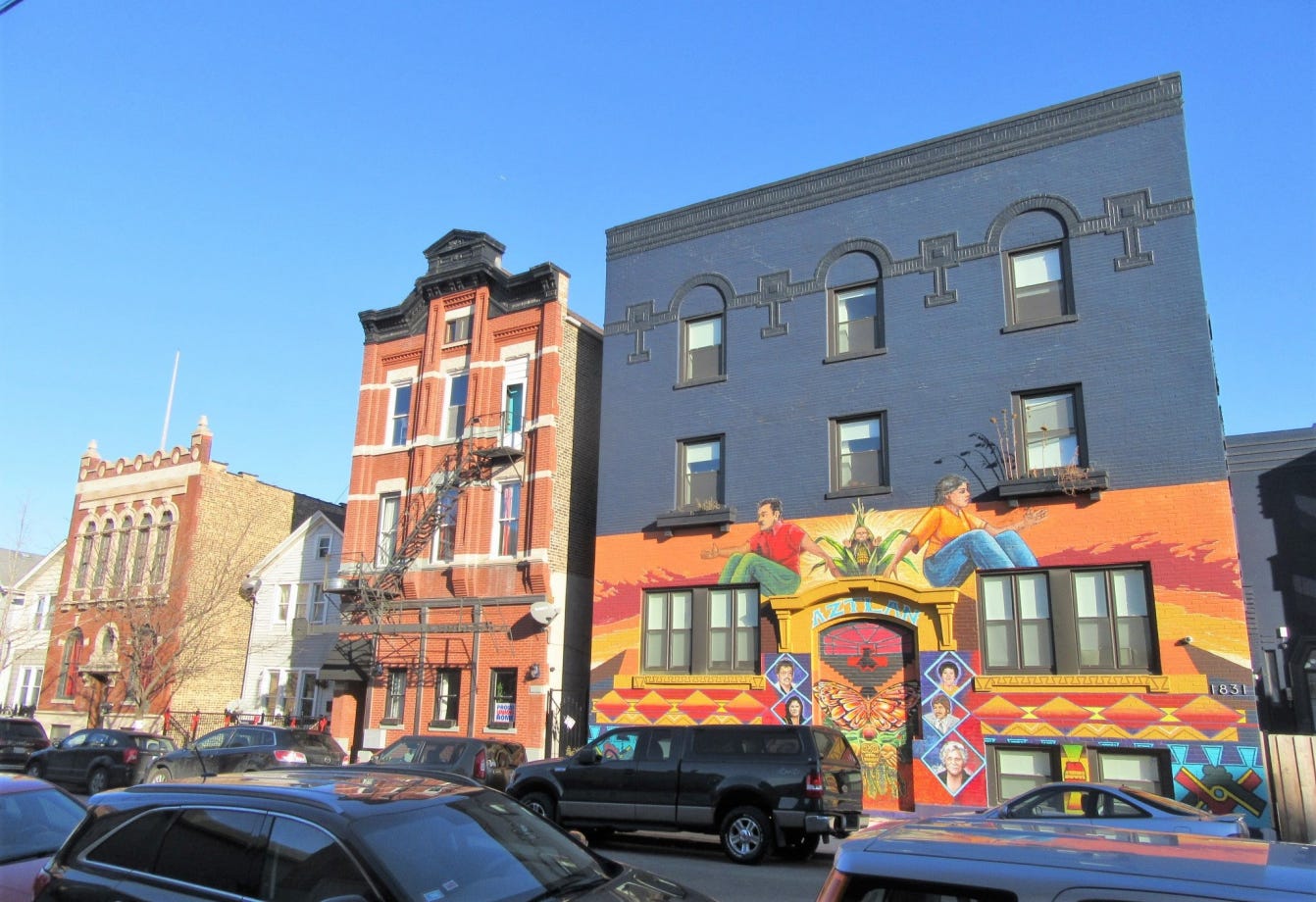
Take Pilsen, for example. Pilsen is a southwest Chicago neighborhood, mostly known for its concentration of Mexican residents. This neighborhood was first established by German and Irish immigrants and later inhabited by Eastern European immigrants. You can see this echoed in its Bohemian-Baroque architecture, which features “ornate, heavy, or unusual parapets, reflecting the aesthetic of the original Czech, Polish, and Lithuanian settlers.”1 These same buildings are now inhabited and adorned by it’s Mexican residents. A walk through the neighborhood and you’ll see this collision of cultures through an environment that reflects both local and global history.
I urge everyone to know the history of the place they live. You might not retain everything you read or hear, but what really matters will stick with you.
When I walk in the city now, there are small architectural flourishes that catch my eye and streets with names of people I know about. It is a comfort to know that the history of the place I live is not just a story to be told, it is the ground I walk on and the air I breath. By living here, I am an extension of that history. And there is something really interesting and meaningful about imagining myself in the context of something grander.
7. Get Into Something
One of the hardest parts of moving is making friends. It is a nearly impossible task that only gets more difficult with age. I’m blessed to say that I now have a bustling and sometimes overwhelming social life, achieved through hard work and incredibly lucky timing. A quick audit of my social life reveals that my closest friends come from one of three places: a team sport, a previous job, or through mutual friends. Let me break this down a little further.
When I say “get into something,” I really mean it. Little communities exist everywhere, and they are slightly inaccessible by design. My second summer in the city, I signed up for a beach volleyball league. I wouldn’t have done this if I hadn’t met a friend earlier that spring that signed up with me. Stroke of luck #1. We joined an independent team, and it was there that I met Bill, who happened to run an already sizable pick-up volleyball group. Stroke of luck #2. I started going religiously, learning new names and faces, desperately trying to rid myself of the unbearable feeling of being an outsider. People I met through the beach league invited me to indoor open gyms and leagues. Up until very recently, I would be saddled with anxiety and self-doubt every time I stepped onto a court. There were times when just showing up to a game was painful. But had I not stuck it through, I wouldn’t have made it to this point, where the games are fun and I’m able to call many of those people my genuine friends.
My best piece of advice if you’re going to join something to meet people? Find an activity that is social in nature. Workout classes are fun, but you can get through a whole class without ever talking to another person. I’m clearly biased towards volleyball, but think about team sports in general: basketball, softball, or even kickball. And don’t stop at physical activity either. What are your local poets up to? Where do the jazz musicians hang out and jam? Find your niche and dig in, any way you can.
The next way in is through a job. Last summer, I worked at a neighborhood restaurant. The job was ridiculous at times and never great money, but the environment was lighthearted and fun. Stroke of luck #1. Days were spent, sweaty, serving margaritas on the rooftop in the middle of a heat wave, while nights were spent, also sweaty, dancing with coworkers at bars I had never been to before.
I still visit the restaurant once every other week or so, for a glass of wine and a catch up. The friends I made at that job have bled over into other areas of my life. A book club and life-changing nights out with Olivia, weekly salsa classes and an Ireland trip with Riley. I feel very lucky to have worked somewhere that doesn’t run on negativity and micromanaging. I know a lot of people have remote jobs nowadays, but if you’re ever considering moonlighting as a server, I would always recommend it.
The last piece of this equation is connecting with mutuals. The friend of your friend is also your friend. I got into the habit of throwing parties years ago, and although it gave me awful anxiety to invite acquaintances into my living space, I grew to love hosting. The internet loves to complain about the lack of free third spaces in the modern age. You just have to be the third space you want to see in the world! Hosting is an act of bringing people together, strengthening community, and holding space for more connections to bloom in your network.
When I hosted, it gave me a chance to see my friends. They would sometimes bring their friends. I would connect with them multiple times in group settings, our defenses slowly falling, without us ever having to do those awkward one-on-one friend dates. Your circle builds and builds this way.
And once you’ve grown your circles, through hobbies, through jobs, through friends, you start to realize you’re a part of something. You get invited to birthday parties and going away parties, you get closer to certain people and further from others, you hear gossip and you’re a part of gossip. At some point, you will feel so viscerally part of the organism. You become inextricably linked to the community you worked so hard to join. And it’s amazing!
Moving is a really difficult task, more than just a logistical nightmare. Ripping up roots and resettling is more emotionally taxing than we give it credit for. To anyone starting over this year—you got this! However you’re reshaping your life, take faith in your ability to bounce back even better than before. If I can do it, I promise you can too. :)
https://www.chicago.gov/content/dam/city/depts/zlup/Historic_Preservation/Publications/Pilsen_Historic_District_Prelim_Summ.pdf
this was so good!! and shoutout merlin, i love that app everyone needs to get on it asap
Grace, you embody the spirit of home! Beautiful. I hope you remain for years to come. You mentioning being reminded of living near an airport in Orlando reminded me of my favorite poem "Self Portrait at 28" by David Berman. Then I was reminded of the song "We are Real" by Silver Jews. (Also David Berman). Also read his poem "The Charm of 5:30." Cheers to feeling grounded by one another <3